Showing posts with label garbage. Show all posts

Sunday, November 29, 2009

Garbage Warrior


I'm going to veer off the traditional book path and review a movie that I recently ordered for my Library. I first read about the concept of Earthships from Chile's blog, Chile Chews, and do want to make sure I give credit where credit is due! As part of my initiative to bring Green books and movies into my Library I've kept an eye out for materials on the concepts and work of eco-friendly housing as it is an increasingly important topic.

Over a year later I encountered reviews of a movie describing the work of renegade eco-architect Michael Reynolds in the wonderful move Garbage Warrior. A brief trailer of the movie is featured above.

Two definitions are important for an understanding of the film's contents:

Earthship n. 1. passive solar home made of natural and recycled materials 2. thermal mass construction for temperature stabilization. 3. renewable energy & integrated water systems make the Earthship an off-grid home with little to no utility bills.

Biotecture n. 1. the profession of designing buildings and environments with consideration for their sustainability. 2. A combination of biology and architecture.

Now both of those definitions sound rather easy to understand in my opinion. We are searching to find ways to develop sustainable housing that use less energy, and perhaps may use readily available ingredients along the way. Unfortunately part of this film documents Reynolds incredible struggle to be allowed to experiment, research and develop concepts that may be crucial to architectural revolutions needed in our coming years with shrinking resources and climate destabilization.

Want to make things much more difficult? Throw in politicians and lobbyists that may have hidden agendas of which we are not aware that decidedly swing our ability to move forward in the opposite directions. Though Reynolds is obviously more the builder than spokesperson to politicians (creative thinker meets a few Type As) he perseveres and manages to make some headway through a restrictive maze of regulations.

There were a few key points that came out during the film that really made me stop and ponder how much we, as regular people, must stand up and support research revolutions. Creating homes that do not contribute to the "grid" of economy, challenging building and construction unions that want maintain the status quo (if you build homes out of recycled ingredients you may be challenging the bricklayers union) and creating a push to allow innovation is incredibly important.

Are safety and building regulations important? Absolutely yes. However part of the struggle is the film is even the right to research and develop beyond our current norms. Obviously we have to start changing how we build both for now and for our future, and without experimentation we will have no success.

Warrior documents the building crew as they take their radical ideas into areas of natural disaster to create self-sufficient housing out of ingredients that are readily available. One home built is made from recovered plastics and features an external lip that will catch and drain water into an underground storage area - also serving as a cooling mechanism for the household above.

The movie is entertaining, nicely paced and ties into our topics of sustainability. The documentary was eventually picked up and supported by the Sundance channel, and you may most likely find it in your local Library. If not, just ask!

I won't give away the ending, but I was left cheering because big change does come in the face of our everyday heros.

Monday, October 12, 2009

Monday Round Up

We weren't exactly lost, but we also didn't know where we were when we came across Florence Street in Sebastopol. Each yard has a sculpture made from discarded metal, the Organic Farmer being only one of many. It is seriously the happiest street I've ever been on.

None of which has a thing to do with books, or reading books, or reviewing books but diversions are sometimes good. I finished Righteous Porkchop - Finding a Life and Good Food Beyond Factory Farms last night. It was a good one; not for the thin skinned however. The realities of factory farming definitely got under my skin and into my dreams too. And I'd read it again in a second. I didn't want to put it down.

First I'm going to read Tracy Kidder's new book I picked up from the library, Strength In What Remains. I loved his last book, Mountains Beyond Mountains, so much I may be setting myself up for disappointment though.

What's up in the world of diversions and books at your house? Any new ones or old ones you want to share? Let us know.

And if you find yourself in Sebastopol, California, don't miss Florence Street. It's happy.

Sunday, September 20, 2009

No Impact Man - The Movie

It's been a long time since I've cried at a movie. But that's exactly what I did last night watching the new documentary, No Impact Man. Not crying really but weeping, appreciation and laughing tears. I fell in love with the whole family it's about; Colin, Michelle and Isabella.

While I was aware from news bites that there was a guy in NY that had given up everything (I never considered what he was gaining) I didn't read his blog or follow. Then Beth at Fake Plastic Fish had an interview post with the guy, Colin, which had me take notice. After that the Green Phone Booth posted a review of his book. I was interested.

I went to the movie with a friend who has never carried a canvas bag; not unlike Colin's wife, Michelle. While I learned new low impact tips from him I was his choir in the audience. More importantly, Michelle related to the audience that had yet to hear the siren's green call. Her distaste for worms, choice words for bike riders; her melt down at giving up caffeine. She spoke from the beauticians chair getting her hair colored and from her air conditioned office at Business Week sucking on ice. And then she cooked her first dinner. We were all changed.

On the way out of the theater my friend asked, "Do you think the growers would refill the plastic shells I buy berries in if I return them to the store?"

I tried not to cry again.

The big ahhh factor is their daughter, Isabella. She was a mimicking sprite; as happy in the dark as she was in the garden.

Admittedly I was biased toward the documentary from the beginning as Colin shopped for local food with flour sack towels and cloth produce bags. He spoke all my favorite things about sourcing food from near by. But he didn't overload our plates with food. He moved on to transportation, household cleaning products, cosmetics; the source of our power. He polished himself up for politics, volunteering, for talking to audiences. And while people were watching him, he was listening to the people doing the watching. Which is where he earned my final respect. He didn't flinch at the truth of criticism but neither did he give up in the face of it.

I'll likely read the book, but the movie was instant gratification, a night out; it was entertainment and inspiration. I give it a five out of five stars and recommend it to any audience. It's a love story, a comedy, drama and adventure. And strange enough to the way most of us live to nearly be considered sci fi.

I'd love to know how the movie impacts you if you have a chance to see it ( here's the schedule). And take a friend. They'll thank you.

Wednesday, July 15, 2009

Farm City: The Education Of An Urban Farmer

(First posted on 6/25/09 at kaleforsale)

I finished the perfect summer read, Farm City, by Novella Carpenter. The trouble is I finished it on the first day of summer. Now what do I do? I don't think anything is going to beat this book.

Farm City is a memoir but it's also bits and parts of how to, or how not to make a garden in the ghetto; on squatted land with an eventual farm yard of animals. The story reads like a novel. The characters are naturally characters; I fell in love with everyone. Except the prostitute looking butcher - there has to be someone not to like.

Novella is quirky, smart, driven and she has a seriously good heart. She made me laugh a lot and look at my own neighborhood with new eyes. There's a deserted house nearby with a sunny front yard that would be a perfect urban garden. The idea had never crossed my mind before. That's what this book does. Novella finds possibility and assistance in places generally looked away from. All is not pretty on the urban farm. Even when I was laughing.

To start with she's farming in Oakland, not Mayberry. A homeless man watches over the garden and offers constant advice. She hauls in free horse manure, forages from local dumpsters to feed the animals. She meets the neighborhood in the garden, invited and not. Even with the weeds and fish heads, I have to admit though, it sounded like fun.

The cute guy is nearly done with Farm City. He laughs out loud too. Stays up too late reading. "Where are you now?" I hungrily ask him. He tells me and we talk about it. It's almost like getting to read the book again.

Which is what I'm going to do - read the book again. That is unless I find an empty lot I can garden.

Rating: Definitely five stars
Recommended for: Gardeners, Gleaners, Memoir Readers, Social Activists and People-that-like-to-laugh

Wednesday, June 17, 2009

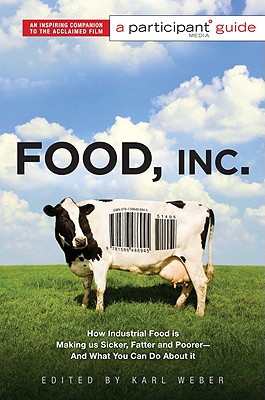
Food, Inc.

I have a crush on Eric Schlosser. I know he's not a movie star or even a farmer but he's got a way of talking about farm workers rights and corn that makes me soft inside. And then when he says, "Monsanto," and his hand flexes into a fist; what can I say?

I'm his.

I didn't read the book but I saw Food, Inc.. Not only does the movie star Eric Schlosser but Michael Pollan was there too. And so was Joel Salatin. They're the three stooges of the know-your-food movement. And I mean that with the utmost respect. These guys were awesome but they're funny too.

The movie was everything a sustainable food girl could want and yet it was just a taste of how food makes its way to the plate. There was a vignette on factory farmed animals, on the treatment of farm workers, of the growing rates of diabetes as a result of cheap food. There was a vignette on GMO's, on government subsidies, on the source of ingredients in food. The movie stayed succinct but could have taken off in any direction for hours. And I would have stayed for all of it.

There were a couple of times I covered my eyes, a couple of times I covered my heart. And a few times my own fist flexed into a fist and I wanted to punch the air and yell, "Yeah. Tell 'em. Way to go!" And then I would get all googley eyed when Eric Schlosser returned to the screen.

The most surprising information was related to the treatment of the migrant farm workers. Forget about how we treat the animals we eat, or the pesticides and fertilizers being flushed into our water ways. Forget about the destruction of top soil and the inability of farmers to save seeds because a patented GMO seed has blown onto their property. Forget about all of that and there are the human beings that handle the food. I wanted to cover my eyes, my heart and ears all at the same time.

The movie is not doom and gloom however. The Stoneyfield Farms guy is one happy dude. And the guys from Walmart? Complete comedic relief. Sure, there are challenges. When hasn't there been? But Food, Inc. is hopeful for the mere fact that it was made. That it's being distributed to major markets. That's it's been reviewed and talked about and linked all over the place.

A friend told me a year and a half ago that the sustainable food movement would never go mainstream. "It's just a trend," this friend said. This movie is not however a trend. It's ambitious, it's smart and hopefully it will whet the appetite for mainstream to start lifting the veil between kitchen tables and food producers everywhere. Hopefully it will raise the momentum of people voting with their forks for fair food that is considerate of all beings.

But mainstream better stay away from Eric Schlosser. He's mine!

Recommended: For people who eat.
Rated: 4 Stars (I don't want to set expectations too high and parts of it are a bit corny!)

Saturday, August 2, 2008

Book Review: Garbage Land


When I buy ice cream from an ice cream shop, I always order the cone. Except for the tiny piece of paper they wrap the tip in, I eat the entire thing. Zero waste, baby! Unfortunately, a three and five year old make messy work out of eating with a cone. It often devolves into the use of a plastic spoon (those I usually remember to carry in my purse) and a paper or Styrofoam cup (those, unlike Burbanmom, I usually don't remember to bring).

Being a good little environmentalist, if reusable is not an option, I always opt for paper over Styrofoam. Everyone knows paper is better. It is biodegradable. Heck, it can even be composted. It's ecological footprint seems downright diminutive compared to the hefty weight of Styrofoam which cannot be composted, does not biodegrade and can only end up in a landfill.

A few months ago, we visited an ice cream shop near my parents' home. I was disappointed that the owner stocked only Styrofoam cups rather than reusable or at least paper. A la Fake Plastic Fish, I wrote an email expressing both our enjoyment of the ice cream and our disappointment in the cup choice. I expected either no reply or one acknowledging that paper would be more eco-friendly and that the store would look into it. What I got surprised me. The owner wrote back, vigorously defending his choice of Styrofoam. He stated that he had grown up near a paper plant and the idea that such an industry had less impact on the environment was, in his opinion, laughable.

Chalking his response up to lack of environmental awareness, I let it go. Until I read Garbage Land: On the Secret Trail of Trash. After romping with Elizabeth Royte in landfills, tiptoeing through recycling plants and burrowing into compost, I know the truth about trash. And, it turns out the store owner's assessment of paper plants was not too far off.

Virgin papermaking is one of the most environmentally harmful industries on
earth. It depletes forests and their biodiversity, it uses more water than
any other industrial process in the nation (more than double the amount of
recycled papermaking), and it dumps billions of gallons of water contaminated
with chlorinated dioxin and a host of other hazardous and conventional
pollutants into rivers, lakes and harbors. According to the Natural
Resources Defense Council (NRDC), the paper industry is, after chemical and
steel manufacturing, the third-largest source of greenhouse gases in the United
States. Each year, paper factories send 420 million metric tons of carbon
dioxide, water vapor, methane, nitrogen oxides, and other heat-trapping gases up
their smokestacks (and emissions are expected to double by 2020). Along
with the gases come 38,617 pounds of lead and 2,277 pounds of mercy and mercury
compounds. The mercury, released by plants’ coal-fired boilers, settles in
water, where bacteria transform it into a highly toxic form called
methylmercury. Small organisms, like plankton, consume the methylmercury
and are in turn consumed by small fish. The small fish are eaten by larger
fish, which are in turn consumed by other animals, like us. . . . . (136)
Hmmm. Perhaps, paper is not so eco-friendly after all.

Garbage Land is full of disturbing discoveries such as this one. Royte delves into everything we toss out and follows it to its final resting place - be it compost bin, landfill, sewage treatment system (Crunchy Chicken's pee party wasn't as out there as I originally thought), recycling plant, or barge to Asia. After 294 pages of trash, she ends up somewhere other than where you'd expect. Or perhaps it is exactly where you would expect someone who lived "garbage" for a year to end up.

I found Garbage Land to be a surprisingly enjoyable, highly educational book. After trimming my own waste line for a year, I learned that I still had a lot to learn about the dirty business of waste.

I give Garbage Land a 4 out of 5 rating and recommend it for all green readers.

Wednesday, July 16, 2008

Rubbish: A second opinion

It's interesting how two people can read exactly the same book and have totally different impressions of it. After reading Arduous's review of "Rubbish! The Archaeology of Garbage," I just had to read it for myself. Consider this a "second opinion" on the book.

Several summers ago, my husband and I took a camping trip to the northern coast of Oregon. We visited Fort Clatsop where explorers Lewis and Clark spent a winter. The original fort is gone, but while we were there we saw actual archaeological digs at the site. My personal impression of archeology is that it is a monstrous amount of tedium punctuated with rare exciting discoveries (kind of like fishing, but that’s a different post). The media reports the exciting discoveries but, naturally, not the tedium. At Fort Clatsop I watched archaeologists painstakingly sort through dust for maybe 15 minutes before I was eager to move on to other sights. An archaeologist I am not.

"Rubbish!" by William Rathje and Cullen Murphy is a book on archeology, only instead of sorting through dust, the archaeologists sort through garbage. One of the main premises of the book is that people are unreliable when reporting their own behavior, while the garbage they produce tells the real story. Members of the "Garbage Project" have spent decades sorting through both fresh garbage right off the truck and old garbage excavated from landfills. Their work has yielded some very interesting, and in many cases counter-intuitive, observations about human behavior.

Reading "Rubbish" made me feel like an archaeologist myself. Pages and pages and pages detailed the painstaking methods that were used to sort through garbage. Chapters and chapters and chapters were filled with more details. Occasionally, I came across one of the fascinating discoveries. Then, more pages of tedium. I fell asleep reading. Twice. I read the 1992 edition, so maybe the later edition is better.

The other beef I had with the book involved some of the conclusions that were drawn from the facts. For example, digs in Mexico City and the US revealed that people who primarily prepare their food from whole foods create more garbage than people who primarily eat pre-packaged foods. It makes sense when you consider that pre-packaged food has been prepared off-site and the inevitable waste has already been dealt with. Many processing plants have secondary uses for food waste as animal feed. When you prepare food yourself, you have to deal with the waste yourself, and the food spoils sooner since there are no preservatives. If people throw the food and waste in the trash, it will take up room in the landfill. The study showed that the wasted pre-processed food plus its packaging took up less space than the wasted whole food plus its packaging. Therefore, the author concluded that the packaging of processed food is not a problem. I, on the other hand, concluded that people need to be taught how to compost.

Another example is disposable diapers. The author argues that they take up "only" 1-2% of the space in the landfill, the energy invested in the diapers an infant wears for a year is equivalent to "only" 53 gallons of gasoline, and the pathogens don't survive, so therefore they are not a problem. Modern landfills are a good way to dispose of garbage and we have plenty of room in the United States to build more landfills. Now I use disposables for my son, but after reading the author's "defense" of disposables, I felt even worse about it! I also question if the percentage of space in the landfill is still accurate because when the study was done, people were still putting most yard debris and recyclable paper into the landfill, but now in communities like mine these are mostly composted or recycled. I expect the percentage has gone up. Besides that, even though landfills are probably necessary, I have no desire to see more of them!

Although the author makes many valid points, there were plenty of other conclusions with which I also disagreed, and I found the details of how they conducted their research to be worthy of an editor’s red pair of scissors. The facts, though, were fascinating. If ever a book would benefit by being made into Cliff Notes, this is it. Rating: 1.5 stars out of 5. Readers: not recommended unless you really dig archeology.

Postnote on a related topic: Since we recycle and compost, my family and I have gotten used to producing very little garbage except for diapers (sigh). This past weekend, though, we went camping with extended family and I was absolutely shocked at how much garbage we generated. This time I was not in charge of the meals, but in the past I've had the same problem myself because of the use of more processed foods and lack of a means of composting. Anybody have any tips on how not to create a lot of trash while camping in the great outdoors?

Tuesday, July 1, 2008

Book Review: Rubbish


To keep things interesting, The Blogging Bookworm will, from time to time, have a special post from fellow bookworms. Our first guest post is from the cutest non-consumer this side of the Mississippi. She's over-ambitious. She's challengilicious. She's Arduous.

Finally a book I can whole-heartedly recommend! Yes, that is right. Rubbish! The Archaeology of Garbage by William Rathje and Cullen Murphy has the Arduous™ seal of approval, so you can head out immediately to check it out of your local library! I will issue one warning, however. Rubbish will make you want to give up your life and head to Arizona to become a garbologist, or at the very least it will make you want to paw through your neighbor’s trash and check out your local landfill. Neither I nor the Blogging Bookworm is in any way liable for any marital strife, discord with friends, or neglect of paying work that may ensue. And now that I’ve gotten that bit of legaleze out of the way, onwards with the book review!

First things first, Rubbish will challenge any and all assumptions you may currently have about garbage. For example, the idea that contemporary society is the most wasteful society to ever walk the Earth? Yeah, not so much. In fact, our per capita garbage disposal is not that different from some of our ancestors. Murphy and Rathje write:
Those who condemn our own era for its conspicuous consumption and conspicuous
waste should at least bear in mind that throwing away perfectly good objects
seems to be one of those inexplicable things, like ignoring history, that human
beings have always done. David Pendergast, an archaeologist who is curator at
the Royal Ontario Museum, in Toronto, spent seven yeas studying a Classic Maya
site─ Altun Ha, in Belize, which was occupied from around 800 B.C. to A.D. 1000─
and after examining the contents of various tombs he concluded: "These people
would have traded in a Cadillac when the ashtray was full."
So contrary to the common belief that humans have never been so wasteful as we are today, it turns out that wanting the shiniest, new thing is a trait we share with our ancestors, and not simply a product of constant advertising. While Americans are producing more waste than we did a hundred years ago, the reason we’re producing more waste is largely because there are more of us now.

If wanting new, pretty things is a human trait, what do we do? While I would love to see people consume less in general. Realistically, I believe that we also need to move towards larger-scale recycling and reusing. Rathje and Murphy state that landfills are 40% composed of paper. Now, Rubbish was written in 1992, so I hope that this number has improved since then. But clearly, if we want to reduce the size of our landfills, we need to step up recycling programs, and ALSO create more of a market for recycled paper products. At the time this book was written, aluminum was the only product for which there was a considerable demand. (I believe this is still true today.) By contrast, the demand for recycled paper products was relatively low, causing tons and tons of used American paper to be shipped to Europe and Asia. Not so awesome. For recycling programs to be truly successful, we must not only recycle, but also buy recycled. And hey, the bright side is, for those of you struggling with giving up your beloved toilet paper or paper towels, there’s a simple solution. Buy recycled products, and instead of feeling guilty, you can feel good that you are helping to create a demand for recycled paper.

I could go on and on about the things I learned from reading Rubbish: that the American reliance on packaged food means that we produce less waste than a household in Mexico City (because packaged food usually results in less food waste), that food shortages tend to produce more waste rather than less waste, and that disposable diapers aren’t the problem. Suffice it to say, this book forced me to re-think my pre-conceived notions about waste. And if that’s not the hallmark of a great read, I don’t know what is!

RATING: 5 out of 5 stars
READERS: Recommended for newly green, medium and dark green readers.